The first time I heard about ClickFunnels, I honestly thought it was just another internet marketing trend that would disappear after a few months. Everywhere I looked, people were talking about funnels, automation, conversions, and online sales systems like they had discovered some secret formula for making money online.
Then I started noticing something interesting.
A lot of real businesses were using it seriously.
Not just influencers trying to sell courses, but coaches, ecommerce brands, consultants, agencies, and even small creators who wanted a simpler way to manage online sales.
That’s what made me curious about clickfunnels pricing in the first place.
Because let’s be honest — when someone asks nearly a hundred dollars every month for software, you naturally want to know whether it’s genuinely useful or just another overhyped tool with aggressive marketing behind it.
After spending time researching the platform, watching how people actually use it, and understanding what the software is designed to do, I realized the answer isn’t black and white.
For some businesses, ClickFunnels can absolutely make life easier.
For others, it’s probably unnecessary.
And that’s exactly why the topic of clickfunnels pricing keeps getting so much attention online.

What ClickFunnels Is Really Designed For
A lot of people assume ClickFunnels is just a website builder.
It’s not.
That’s probably the biggest misunderstanding beginners have when they first look at the platform.
Traditional websites are built for browsing. People click around, open menus, read blog posts, jump between pages, and explore different sections however they want.
Funnels work differently.
Funnels guide visitors through a specific path.
For example:
Someone clicks an ad.
They land on a page with one clear message.
They enter their email.
They see an offer.
They buy a product.
Then follow-up emails continue automatically.
Everything moves step by step.
That structure is why businesses focused on online sales often care more about clickfunnels pricing than standard website costs.
The platform is built around conversions rather than simple page design.
Why Clickfunnels Pricing Feels Expensive at First
I think most people have the same initial reaction when they see the monthly plans.
“Why does this cost so much?”
And honestly, that reaction makes sense.
If you compare ClickFunnels to basic website platforms, the difference in price feels huge.
A beginner website builder might cost:
- $10 monthly
- Maybe $20 with extra features
Meanwhile ClickFunnels starts around:
- $97 per month
So naturally people start questioning whether the extra cost is justified.
But after looking deeper, I realized ClickFunnels isn’t really trying to compete with cheap website builders.
It’s positioning itself more like an online sales system.
Whether that system is worth paying for depends entirely on how serious your business is about online selling.
Clickfunnels Pricing Plans Explained Simply
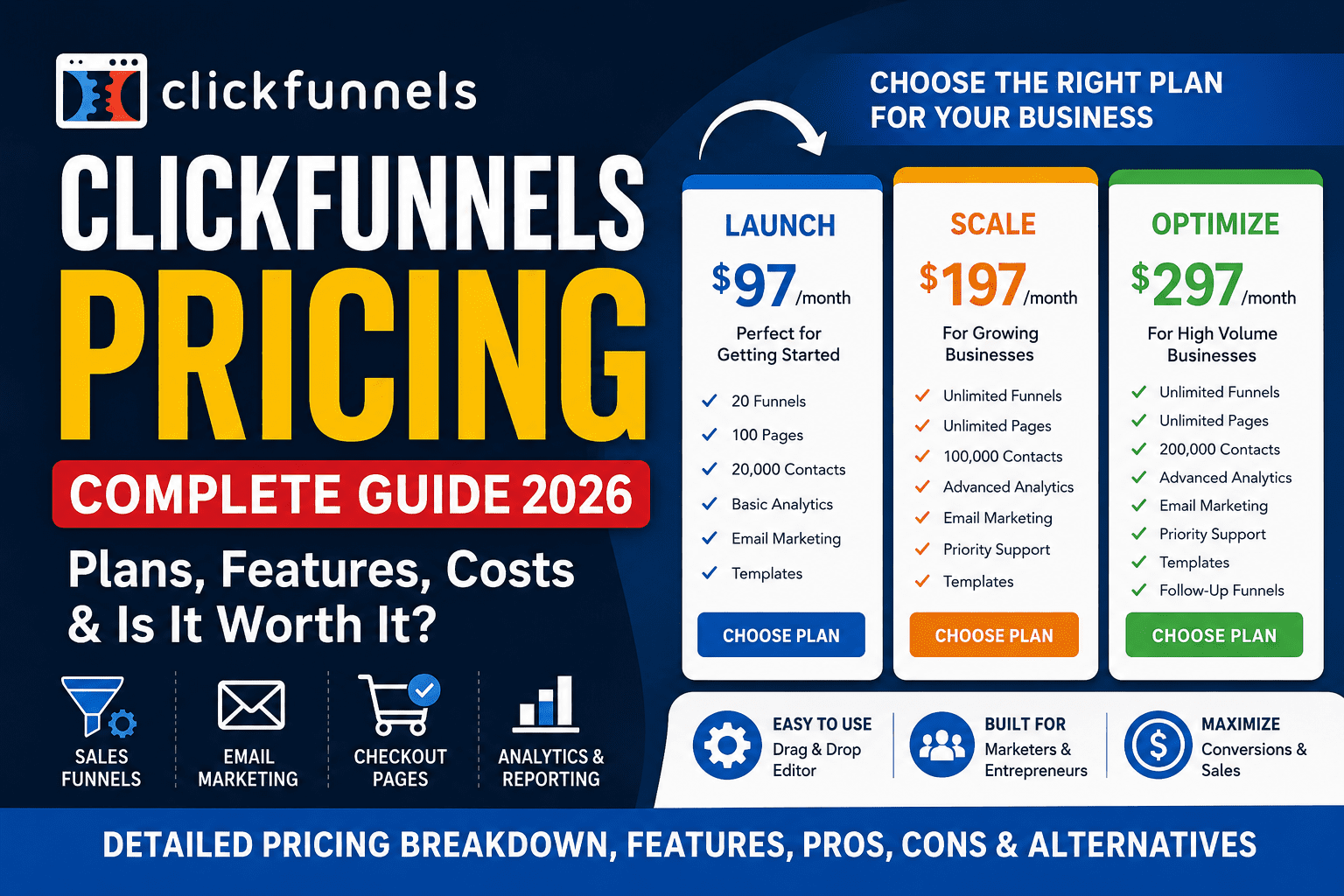
Launch Plan — $97 Monthly
This is the plan most people start with.
If someone is new to funnels or running a smaller online business, this is usually the entry point.
The Launch Plan generally includes:
- Funnel creation
- Landing pages
- Checkout pages
- Basic email tools
- Templates
- Lead collection
- Analytics
For beginners researching clickfunnels pricing, this plan often feels like the safest option because it gives access to the core features without jumping straight into higher monthly costs.
And honestly, for many small businesses, it’s probably enough.
Especially if you’re selling:
- Digital products
- Coaching sessions
- Affiliate offers
- Online services
- Small courses
Scale Plan — $197 Monthly
The Scale Plan feels more focused on growing businesses rather than beginners.
At this level, businesses usually want:
- More automation
- Higher limits
- Better customer tracking
- Advanced funnel management
- More scalability
This is where businesses running regular advertising campaigns often start paying attention.
Because once traffic increases, organization becomes more important.
A simple setup that worked for a small audience may suddenly become messy when thousands of people start entering funnels every month.
That’s one reason some businesses are comfortable paying higher clickfunnels pricing over time.
Optimize Plan — $297 Monthly
Honestly, this plan is probably unnecessary for most beginners.
The Optimize Plan seems aimed more at businesses already making serious revenue online.
At this point, users are usually managing:
- Multiple funnels
- Larger customer lists
- Advanced marketing systems
- High-volume campaigns
For those businesses, software cost becomes less important than efficiency and performance.
What I Think ClickFunnels Actually Does Well
After looking at different platforms, I think ClickFunnels succeeds mainly because it simplifies complicated processes.
A lot of online business tools require:
- Extra integrations
- Technical setup
- Plugin management
- Constant troubleshooting
That stuff becomes exhausting quickly.
ClickFunnels tries to keep everything connected in one place.
For non-technical entrepreneurs, that convenience matters more than people realize.
Especially when they want to focus on:
- Selling
- Marketing
- Building offers
- Working with customers
Instead of spending hours fixing software problems.

But Here’s What Beginners Need to Understand
Software alone doesn’t create successful businesses.
I think this is where many people get disappointed.
Some beginners subscribe expecting funnels to magically generate money.
But funnels still need:
- A real offer
- Clear messaging
- Good traffic
- Customer trust
- Strong marketing
Without those things, even the best funnel software won’t help much.
That’s why I think conversations about clickfunnels pricing sometimes become unfair.
People blame the software for problems that are actually business strategy issues.
The Hidden Costs Most People Ignore
Another thing I noticed while researching ClickFunnels is that the subscription itself is rarely the only expense.
Businesses often spend additional money on:
- Advertising
- Copywriting
- Video creation
- Graphic design
- Email campaigns
- Freelancers
In fact, for businesses running paid ads seriously, software may become one of the smaller monthly expenses overall.
That changes how experienced marketers look at pricing.
Instead of asking:
“Is this software expensive?”
They ask:
“Can this software help improve conversions enough to justify the cost?”
That’s a completely different mindset.
Who Probably Benefits Most From ClickFunnels
After looking at different business models, I think funnels naturally fit certain industries better than others.
Coaches and Consultants
Funnels work extremely well for:
- Webinar registration
- Consultation booking
- Lead generation
Affiliate Marketers
Many affiliates build email lists through funnels before promoting offers.Course Creators
Online education businesses often rely heavily on funnel systems.Ecommerce Brands
Some ecommerce stores use funnels for:
- Upsells
- Product launches
- Limited-time offers
- Cart recovery
For these businesses, better conversions can sometimes justify higher clickfunnels pricing pretty quickly.
When ClickFunnels Might Be Too Much
At the same time, not every business needs advanced funnel software.
Sometimes entrepreneurs buy expensive tools before they actually need them.
If someone is:
- Still testing ideas
- Unsure what they want to sell
- Working with a tiny budget
- Getting almost no traffic
…then simpler tools may honestly make more sense at the beginning.
That doesn’t mean ClickFunnels is bad.
It just means timing matters.
Clickfunnels Pricing vs Other Platforms
Leadpages
Leadpages is often cheaper and easier for simple lead generation.
Good for:
- Basic pages
- Email collection
- Smaller campaigns
ThriveCart
ThriveCart attracts people who prefer one-time payments instead of monthly subscriptions.
WordPress Funnel Systems
WordPress users often build custom funnels using plugins and themes.
That approach offers flexibility but usually requires more technical work.
Some people prefer convenience. Others prefer control.
ClickFunnels Pricing in 2026: The Things Most Reviews Don’t Tell You
When people talk about clickfunnels pricing, the conversation usually focuses only on numbers.
You’ll hear things like:
- “It starts at $97.”
- “The higher plans cost more.”
- “There are cheaper alternatives.”
But after spending time researching how businesses actually use funnels, I realized the pricing discussion is much deeper than that.
Because the real question isn’t:
“How much does ClickFunnels cost?”
The real question is:
“What kind of business actually benefits from paying for it?”
That changes the entire conversation.
A lot of beginners see funnel software as some magical shortcut to online income. The marketing around funnels sometimes makes it sound like you can launch a few pages, run traffic, and suddenly watch money appear automatically.
Real business doesn’t work that way.
Funnels can help organize sales processes. They can improve conversions. They can simplify customer journeys.
But they still need strategy behind them.
And honestly, I think understanding that is more important than memorizing every level of clickfunnels pricing.
Why Funnels Became So Popular
The reason funnel software exploded over the last few years is actually pretty simple.
Traditional websites often overwhelm visitors.
Think about it.
You open a normal website and immediately see:
- Menus
- Blog links
- Social media buttons
- Multiple products
- Popups
- Navigation bars
People get distracted fast.
Funnels remove most of that noise.
Instead of giving visitors unlimited choices, funnels focus attention on one action at a time.
Maybe it’s:
- Entering an email
- Buying a product
- Booking a consultation
- Registering for a webinar
That focused structure is why businesses started paying serious attention to platforms like ClickFunnels.
Not because funnels are magic.
But because clarity usually improves conversions.
One Thing Most Beginners Misunderstand
A lot of beginners think ClickFunnels creates successful businesses.
It doesn’t.
It creates systems.
That’s a huge difference.
The software can help organize:
- Landing pages
- Checkout flows
- Email sequences
- Lead capture
- Customer journeys
But it still cannot replace:
- A strong offer
- Real demand
- Good communication
- Trust
- Audience understanding
I think this is where frustration usually starts.
Some people buy funnel software before they even know what they’re selling.
Then they wonder why nothing works.
The problem usually isn’t the platform.
It’s the lack of business direction.
The Emotional Side of Clickfunnels Pricing
This is something almost nobody talks about openly.
For many beginners, paying nearly $100 every month feels emotionally uncomfortable.
Especially at the beginning.
When revenue is unpredictable, every subscription feels bigger than it actually is.
That’s why people obsess over clickfunnels pricing online.
They aren’t only comparing features.
They’re trying to justify risk.
And honestly, that’s completely normal.
Most entrepreneurs start cautiously because they don’t want to waste money on tools they may never fully use.
What Businesses Usually Get the Best Results
After looking at real-world use cases, certain business models seem naturally suited for funnels.
Coaching Businesses
Funnels work really well for coaches because they create structured customer journeys.
For example:
- Free webinar
- Consultation booking
- Paid program offer
- Follow-up email sequence
Everything flows naturally.
Course Creators
Online education businesses often rely heavily on funnels.
Especially when launching:
- Courses
- Memberships
- Workshops
- Digital downloads
Funnels help guide potential customers through the decision-making process step by step.
Affiliate Marketing
Affiliate marketers often use funnels differently.
Instead of sending traffic directly to offers, they first collect emails and build trust over time.
That strategy can increase long-term revenue significantly.
Ecommerce Stores
Some ecommerce brands use funnels for:
- Product launches
- Upsells
- Bundle offers
- Limited promotions
In ecommerce, even small conversion improvements can create major revenue differences over time.
That’s one reason some businesses feel comfortable with higher clickfunnels pricing.
The Biggest Mistake New Users Make
Honestly, I think many beginners buy software too early.
That happens constantly online.
People see successful marketers using advanced tools and assume they need the same setup immediately.
But software should solve problems that already exist.
For example:
- Too many leads to manage
- Poor conversion rates
- Complicated customer flows
- Disorganized marketing systems
If those problems don’t exist yet, expensive software may not help much.
That’s why I think timing matters more than hype.
Is ClickFunnels Overpriced?
This depends entirely on perspective.
Why Some People Say Yes
From a beginner’s point of view, the monthly cost can definitely feel high.
Especially compared to:
- Basic website builders
- Cheap landing page tools
- Simple email platforms
For someone just starting online, recurring software costs add pressure quickly.
Why Other Businesses Don’t Care About the Cost
For established businesses, the calculation looks different.
If funnels help increase:
- Leads
- Sales
- Customer retention
- Average order value
…then the software may pay for itself easily.
At that point, business owners care more about efficiency than subscription price.
That’s why opinions about clickfunnels pricing vary so much online.
Different businesses are solving different problems.
What I Personally Think ClickFunnels Does Best
After looking at different platforms, I think ClickFunnels succeeds mainly because it simplifies complexity.
A lot of online systems become messy over time.
Different tools stop syncing properly.
Plugins break.
Integrations fail.
Updates create problems.
That technical chaos frustrates people fast.
ClickFunnels tries to keep everything connected inside one ecosystem.
That convenience is probably the platform’s biggest strength.
Especially for entrepreneurs who don’t enjoy technical work.
But Simplicity Has Trade-Offs
At the same time, all-in-one platforms usually sacrifice some flexibility.
That’s true for almost every software ecosystem.
Some advanced users eventually prefer custom setups because they want:
- More control
- Better SEO flexibility
- Advanced customization
- Lower long-term costs
That’s why some businesses eventually move toward custom WordPress systems or other specialized tools.
There’s no perfect platform for everyone.
Clickfunnels Pricing vs Building Everything Yourself
Technically, you can build funnels using cheaper combinations of tools.
For example:
- WordPress
- Email software
- Landing page plugins
- Checkout systems
- Automation tools
Sometimes that setup costs less overall.
But it also requires:
- More maintenance
- More troubleshooting
- More technical understanding
Some entrepreneurs prefer saving money.
Others prefer saving time.
That usually determines which direction they choose.
Why Some Businesses Stay With ClickFunnels Long-Term
One thing I noticed is that businesses already generating revenue often stay because switching systems becomes difficult later.
Once funnels, automations, emails, customer flows, and checkout systems are fully connected, migration takes effort.
That creates long-term platform loyalty.
Especially for businesses where funnels are deeply integrated into daily operations.
Final Thoughts on Clickfunnels Pricing
After researching everything carefully, I think clickfunnels pricing only makes sense when viewed through a business lens instead of a beginner mindset.
If someone expects software alone to create success, the platform will probably disappoint them.
But if a business already has:
- Real offers
- Consistent traffic
- Customer understanding
- Marketing direction
…then funnel systems can genuinely improve organization and conversions.
At the end of the day, ClickFunnels isn’t really selling pages.
It’s selling structure.
And for the right type of business, that structure can absolutely be valuable.
You have not enough Humanizer words left. Upgrade your Surfer plan.