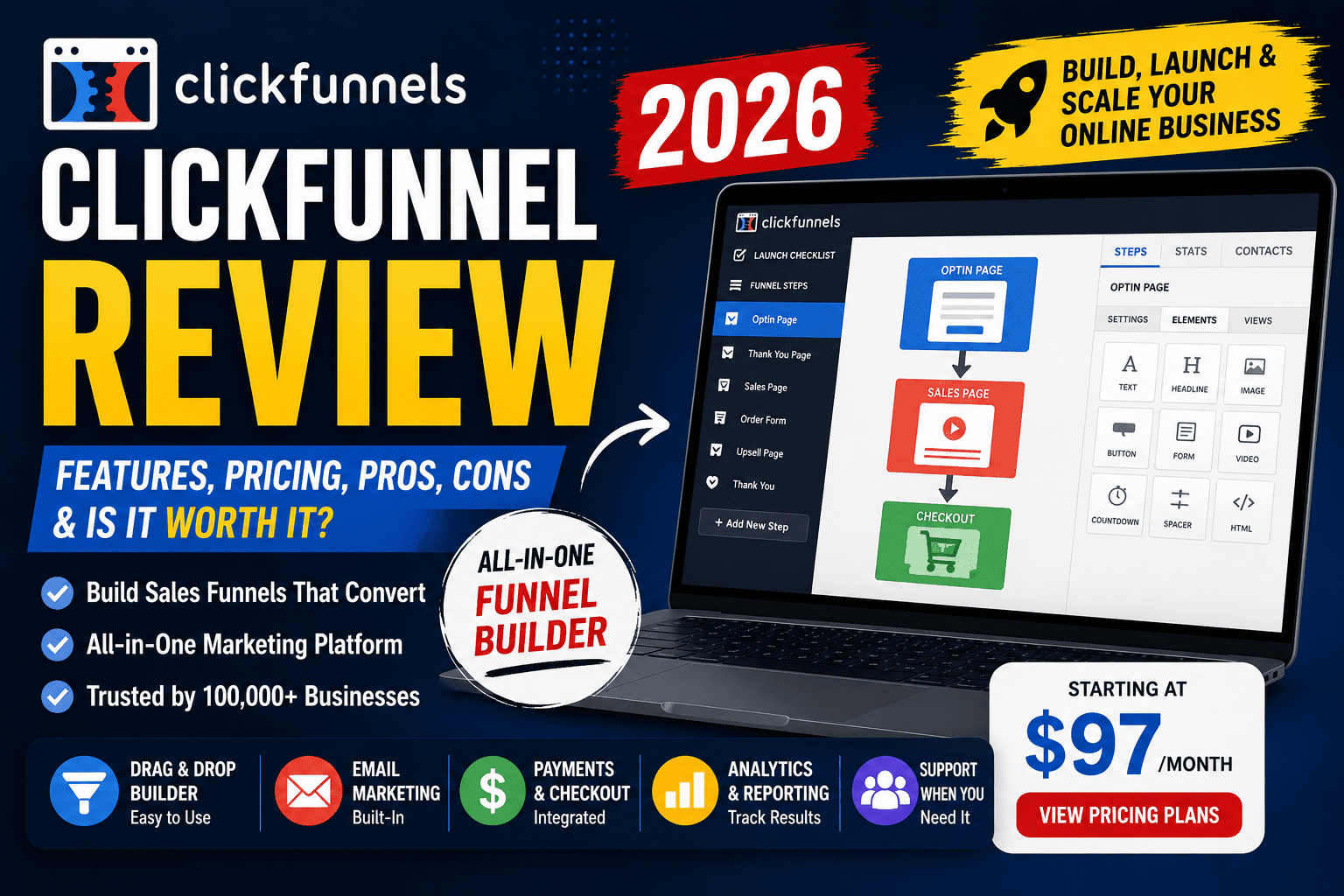
If you spend enough time researching online business tools, you’ll eventually come across ClickFunnels. Some people call it the ultimate funnel builder. Others think it’s overpriced. And honestly, after looking deeper into the platform, I can understand both opinions.
The reason the word clickfunnel keeps appearing everywhere online is because businesses today care more about conversions than ever before.
Getting traffic is already difficult.
Keeping visitors focused long enough to actually buy something is even harder.
That’s where funnels became popular.
Instead of sending people to complicated websites full of distractions, funnels guide visitors through one clear path step by step.
And whether people love or criticize ClickFunnels, there’s no denying the platform changed how many online businesses approach selling on the internet.

What Is ClickFunnel Actually Meant to Do?
A lot of beginners think ClickFunnels is just another website builder.
It’s not.
Traditional websites are built for browsing.
Funnels are built for movement.
That’s the biggest difference.
A normal website lets visitors:
- Open menus
- Read blogs
- Jump between pages
- Explore different sections
Funnels work differently.
Funnels guide people toward one specific action at a time.
For example:
A visitor clicks an advertisement.
They land on a focused page.
They enter their email address.
They see an offer.
They complete checkout.
Then follow-up emails continue automatically.
Everything follows a sequence.
That structure is why businesses focused on online sales continue paying attention to clickfunnel systems in 2026.
Why Funnels Became So Popular
Honestly, most websites overwhelm people.
Think about what usually happens when someone opens a homepage.
They immediately see:
- Navigation menus
- Social media links
- Product categories
- Popups
- Multiple offers
- Blog links
Most visitors lose focus quickly.
Funnels simplify the process.
Instead of giving people ten choices, funnels usually present one clear next step.
That clarity often improves conversions because visitors don’t feel distracted.
And honestly, once I understood that properly, the popularity of clickfunnel marketing started making much more sense.
Why Businesses Use ClickFunnels
The biggest reason businesses use ClickFunnels is convenience.
Many online systems become messy over time.
One tool handles:
- Landing pages
Another handles:
- Email marketing
Another processes:
- Payments
Another tracks:
- Leads and customers
Trying to connect everything together becomes frustrating fast.
ClickFunnels tries to keep all those systems inside one platform.
For non-technical entrepreneurs, that simplicity matters a lot.
Especially when they’d rather spend time:
- Selling
- Creating offers
- Running ads
- Talking to customers
Instead of troubleshooting software problems all day.
Is ClickFunnels Beginner Friendly?
This is where opinions become mixed.
Why Beginners Like It
One thing ClickFunnels does well is reducing technical stress.
You usually don’t need:
- Coding skills
- Developers
- Advanced design experience
- Complex integrations
The drag-and-drop system is relatively simple compared to building custom websites manually.
That convenience is a huge reason many beginners feel attracted to clickfunnel software.
Why Some Beginners Still Struggle
At the same time, funnels still require real marketing.
The software cannot magically create:
- Good products
- Customer trust
- Strong offers
- Traffic
- Persuasive messaging
Some people subscribe expecting automatic online income.
Then frustration happens when results don’t appear immediately.
The problem usually isn’t the platform itself.
It’s unrealistic expectations.
Funnels are tools.
They still need strategy behind them.
The Real Cost of Running Funnels
One thing many people don’t realize is that software itself is rarely the biggest expense.
Businesses often spend additional money on:
- Advertising
- Copywriting
- Graphic design
- Video editing
- Email campaigns
- Freelancers
- Traffic generation
In some businesses, funnel software becomes one of the smaller monthly expenses overall.
That’s why experienced marketers usually focus less on subscription price and more on return on investment.
If a funnel improves:
- Leads
- Sales
- Conversion rates
- Customer retention
…then the software may easily justify its cost.
What Types of Businesses Benefit Most?
After researching different business models, funnels naturally fit certain industries extremely well.
Coaches and Consultants
Funnels work great for:
- Webinar registration
- Consultation booking
- Lead generation
- Follow-up automation
Course Creators
Online education businesses rely heavily on customer journeys.
Funnels help guide people from interest to purchase in a more structured way.
Affiliate Marketers
Many affiliates use funnels to collect emails before promoting products.
That long-term strategy often increases revenue significantly over time.
Ecommerce Brands
Some ecommerce businesses use funnels for:
- Product launches
- Upsells
- Limited offers
- Cart recovery systems
For businesses already generating sales, even small conversion improvements can create large revenue differences.
Why Some People Think ClickFunnels Is Overhyped
At the same time, not everyone loves the platform.
Some users feel the marketing around clickfunnel software becomes too exaggerated.
You’ve probably seen ads promising:
- Easy online income
- Automated sales
- Fast business growth
But real business usually takes more work than advertisements suggest.
Funnels can absolutely help improve organization and customer flow.
But they still need:
- Traffic
- Testing
- Strategy
- Patience
- Good communication
Without those things, no software will suddenly create success.
Clickfunnels vs Traditional Websites
This comparison matters because many beginners confuse the two.
Traditional websites are useful for:
- Blogging
- SEO
- Brand presence
- General browsing
Funnels are more focused on:
- Conversions
- Lead generation
- Sales flow
- Specific customer actions
Many successful businesses actually use both together.
A website builds trust and visibility.
Funnels help convert traffic into leads and customers.
Why Some Businesses Stay With ClickFunnels Long-Term
Once businesses build entire customer systems inside funnels, switching becomes difficult.
Funnels often connect:
- Email sequences
- Checkout systems
- Lead management
- Product delivery
- Customer tracking
Migrating everything somewhere else takes time and effort.
That’s one reason many businesses stay loyal to their funnel systems for years.
Especially if the funnels are already producing revenue consistently.
When Funnels Might Be Too Much
At the same time, not every business needs advanced funnel systems immediately.
Sometimes entrepreneurs buy expensive tools too early.
You may not need complex funnels yet if:
- You’re still testing ideas
- You have almost no traffic
- You don’t know your audience yet
- Your budget is very limited
- You only need a basic website
In those situations, simpler tools may honestly make more sense at the beginning.

The Emotional Side of Building an Online Business
One thing I noticed while researching clickfunnel systems is that many people aren’t just buying software.
They’re buying hope.
That sounds dramatic, but it’s true.
A lot of entrepreneurs feel overwhelmed trying to build an online business today.
There’s pressure everywhere:
- More competition
- Rising advertising costs
- Constant algorithm changes
- Too many marketing tools
- Endless advice online
So when a platform promises a more organized way to sell online, people naturally pay attention.
And honestly, I understand why.
Funnels create structure.
Instead of guessing what customers should do next, businesses can guide them step by step through a clearer process.
For many entrepreneurs, that alone reduces a huge amount of stress.
Why Simplicity Matters More Than People Think
One thing successful online businesses often have in common is simplicity.
Not necessarily simple products.
Simple customer journeys.
Most people online become distracted incredibly fast.
You probably do it yourself without noticing.
You open a website, see too many choices, lose focus, and leave within seconds.
Funnels try to solve that problem.
Instead of overwhelming visitors, they focus attention on one action at a time.
Maybe it’s:
- Downloading a guide
- Entering an email
- Booking a consultation
- Purchasing a product
That focused experience is one reason businesses continue investing heavily in clickfunnel systems even with increasing competition in the software market.
Why Some Funnels Fail Completely
This is something almost nobody talks about honestly.
Not every funnel works.
In fact, many fail badly.
And usually the reason isn’t the software itself.
Funnels fail because:
- The offer is weak
- The messaging is confusing
- The audience targeting is wrong
- Traffic quality is poor
- The business expects instant results
A funnel simply organizes the customer journey.
It cannot magically create demand where none exists.
That’s why I think expectations matter so much when people first start using ClickFunnels.
The software can help structure marketing.
But it still needs a strong business behind it.
The Biggest Difference Between Beginners and Experienced Marketers
Beginners usually focus on tools.
Experienced marketers focus on systems.
That’s a huge mindset difference.
New entrepreneurs often ask:
“What software should I buy?”
Experienced businesses ask:
“How do we improve conversions and customer flow?”
Funnels become valuable when businesses start thinking in systems instead of isolated pages.
For example:
- Where does traffic come from?
- What happens after lead capture?
- How are follow-ups handled?
- Where are customers dropping off?
- Which offers convert best?
Funnels help businesses organize those processes more clearly.
That’s where the real value usually appears.
Why Businesses Pay for Convenience
Some people criticize funnel software pricing because cheaper alternatives exist.
And technically, they’re right.
You can build custom systems using:
- Website builders
- Email software
- Checkout platforms
- Plugins
- Automation tools
Sometimes that setup costs less overall.
But it also creates:
- More maintenance
- More troubleshooting
- More integrations
- More technical complexity
For some business owners, saving time matters more than saving subscription costs.
Especially if they’d rather focus on:
- Sales
- Marketing
- Content creation
- Customer relationships
Instead of constantly fixing software issues.
That convenience is a major reason platforms like ClickFunnels remain popular despite heavy competition.
Why Funnels Work Well for Digital Products
Funnels naturally fit digital businesses extremely well.
Especially businesses selling:
- Courses
- Memberships
- Coaching
- Templates
- Ebooks
- Webinars
Because digital products often require more explanation before customers buy.
Funnels help guide people through that process gradually.
For example:
- Free lead magnet
- Email sequence
- Webinar invitation
- Product offer
- Upsell or follow-up
Everything feels connected instead of random.
That structure often improves trust and conversions over time.
Why Some Ecommerce Brands Use Funnels Too
A lot of people assume funnels only work for coaching businesses or online courses.
But many ecommerce stores use funnels as well.
Especially for:
- Product launches
- Limited-time offers
- Bundle promotions
- Upsells
- Cart recovery
Even small conversion improvements matter hugely in ecommerce.
If a business already gets large traffic volume, increasing conversions slightly can create major revenue growth.
That’s one reason established ecommerce businesses often continue investing in clickfunnel systems.
The Problem With “Easy Money” Marketing
Honestly, I think some of the criticism around funnel platforms comes from unrealistic marketing promises online.
You’ve probably seen ads claiming:
- Automated income
- Passive sales
- Fast online success
- Easy business growth
But real businesses rarely work that way.
Funnels can absolutely help improve organization and customer journeys.
But they still require:
- Testing
- Patience
- Traffic
- Good offers
- Audience understanding
Without those things, even expensive funnel systems won’t produce great results.
That’s why I think expectations matter more than software features.
What Beginners Should Focus on First
If someone is completely new to online business, I honestly think the first priority should be:
- Understanding customers
- Creating a useful offer
- Learning basic marketing
- Building trust
Funnels become far more valuable after those foundations exist.
Sometimes entrepreneurs buy advanced tools before they even know:
- Who their audience is
- What problem they solve
- How they’ll get traffic
In those situations, software usually becomes a distraction instead of a solution.
Why ClickFunnels Still Stands Out
Even with growing competition, ClickFunnels still remains one of the most recognized funnel platforms online.
And honestly, I think that mainly comes down to simplicity.
The platform tries to keep:
- Pages
- Funnels
- Automations
- Customer flows
- Checkout systems
…inside one ecosystem.
For businesses that dislike technical complexity, that convenience matters a lot.
Especially when time becomes more valuable than software costs.
Final Thoughts on ClickFunnel Platforms
After researching everything carefully, I think funnels work best when businesses already have direction.
Not when they’re searching for shortcuts.
Funnels can absolutely help:
- Improve conversions
- Organize customer journeys
- Simplify online selling
- Create better follow-up systems
But they still depend heavily on:
- Real demand
- Strong offers
- Marketing strategy
- Consistency
- Patience
For the right business, clickfunnel systems can genuinely simplify growth and customer flow.
For the wrong business, they may simply become another monthly expense with no clear purpose.
And honestly, that’s probably the most realistic way to look at funnel software in 2026.